
musings from the studio and beyond ~
dawn chandler’s reflections on art and life. . . .
amulets of the trail
 pause
“SPLAT”
pause
“SPLAT”
pause
“SPLAT”
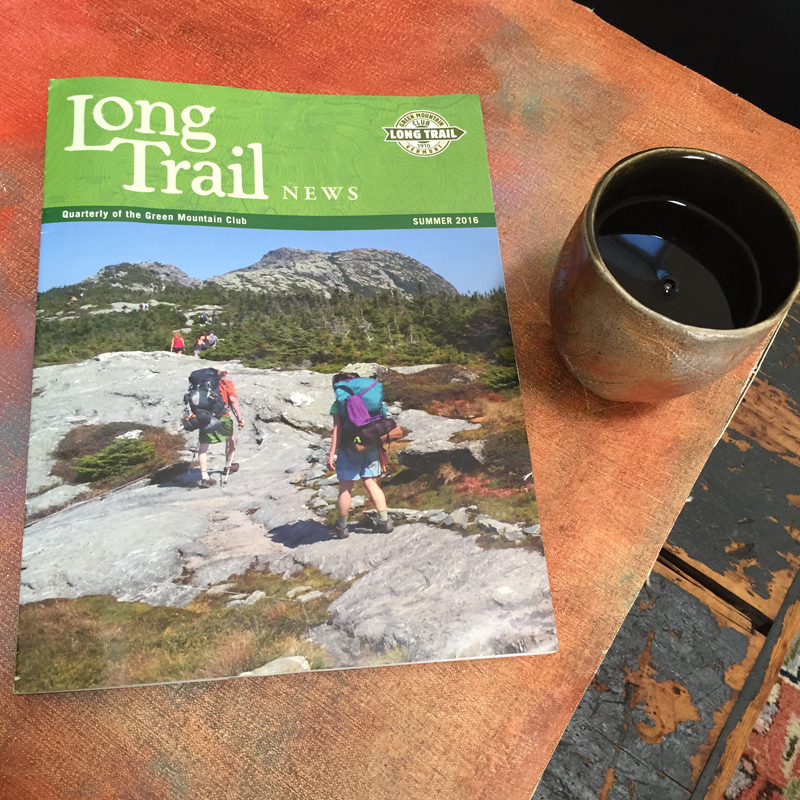
…was the sound as I emptied my PO box this afternoon, depositing most of its contents into the waste bin of recycled trees. Of the 4-inch stack of mail in my little locked cubbie-hole, the only thing worth saving was one magazine: the latest issue of The Long Trail News, the quarterly publication of Vermont’s Green Mountain Club.
I sometimes hesitate to look at The Long Trail News. Because I know I’m going to feel pain when I look at it. The pain of near heart-bursting longing to return to Vermont; to get back on The Trail.
This afternoon was no different. Upon returning home I considered leaving the magazine in my bag, for I felt weary. Weary of the interminable election. Weary of alarming news stories. Weary of the day’s heat. . . of cleaning house. . . of not enough sleep. I needed a break.
Hmmm…Maybe I did want to look at it now, and let my mind escape to Vermont.
Settling into a comfy chair in my living room, mug of tea in one hand and The Long Trail News in the other, I started, for whatever reason, at the back, on the last page. There I found “From the Journal of Idgie,” by a woman I’d met on the trail. Though she likely wouldn’t remember me, we shared a room with several others at Inn at Long Trail two weeks into my hike. She started her hike on September 13th and finished on October 6th. Four weeks — just a little shy of what I’d hoped to hike it in.
But she finished.
And I haven’t.
Yet.
My heart tightened a little with envy.
I skimmed forward a few pages, noting articles and announcements I’ll return to later, for more careful reading.
Then I got to the center of the magazine, where my heart constricted as I read the huge bold headline:
YOU DID IT!
171 Hikers Complete 272-Mile Footpath Through Green Mountains: Congratulation to the following hikers who walked the rugged footpath over the Green Mountain Range from the Massachusetts border to the Canadian border and became Long Trail end-to-enders.
And there listed were the names of the 171 thru-hikers of 2015.
pause
“SPLAT”
pause
“SPLAT”
pause
“SPLAT”
…was the sound as I emptied my PO box this afternoon, depositing most of its contents into the waste bin of recycled trees. Of the 4-inch stack of mail in my little locked cubbie-hole, the only thing worth saving was one magazine: the latest issue of The Long Trail News, the quarterly publication of Vermont’s Green Mountain Club.
I sometimes hesitate to look at The Long Trail News. Because I know I’m going to feel pain when I look at it. The pain of near heart-bursting longing to return to Vermont; to get back on The Trail.
This afternoon was no different. Upon returning home I considered leaving the magazine in my bag, for I felt weary. Weary of the interminable election. Weary of alarming news stories. Weary of the day’s heat. . . of cleaning house. . . of not enough sleep. I needed a break.
Hmmm…Maybe I did want to look at it now, and let my mind escape to Vermont.
Settling into a comfy chair in my living room, mug of tea in one hand and The Long Trail News in the other, I started, for whatever reason, at the back, on the last page. There I found “From the Journal of Idgie,” by a woman I’d met on the trail. Though she likely wouldn’t remember me, we shared a room with several others at Inn at Long Trail two weeks into my hike. She started her hike on September 13th and finished on October 6th. Four weeks — just a little shy of what I’d hoped to hike it in.
But she finished.
And I haven’t.
Yet.
My heart tightened a little with envy.
I skimmed forward a few pages, noting articles and announcements I’ll return to later, for more careful reading.
Then I got to the center of the magazine, where my heart constricted as I read the huge bold headline:
YOU DID IT!
171 Hikers Complete 272-Mile Footpath Through Green Mountains: Congratulation to the following hikers who walked the rugged footpath over the Green Mountain Range from the Massachusetts border to the Canadian border and became Long Trail end-to-enders.
And there listed were the names of the 171 thru-hikers of 2015.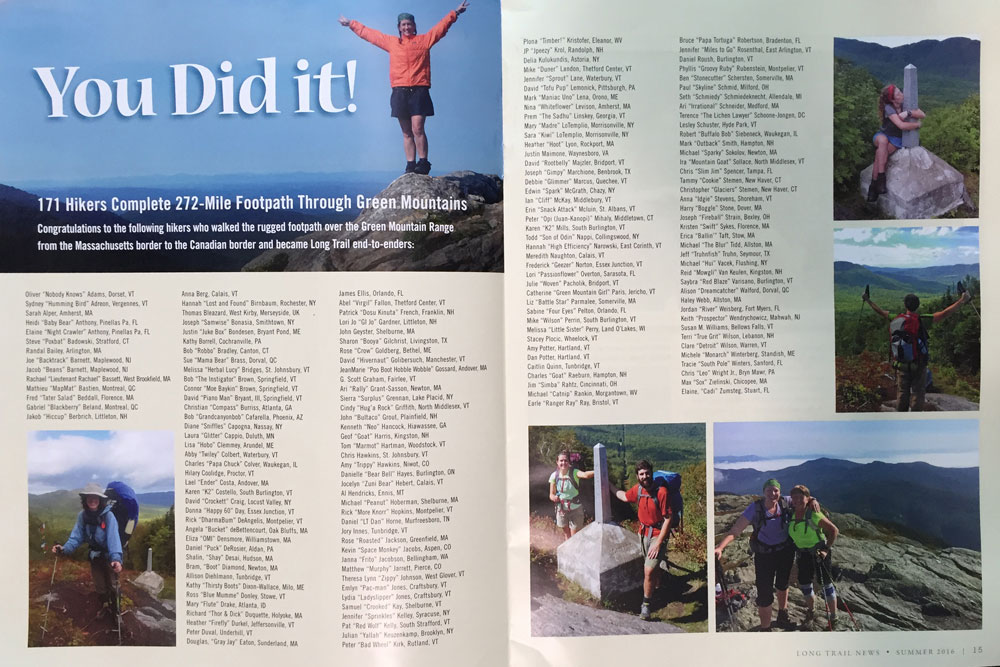 I would have been 172.
I swallowed hard, and read through the names, my mind a stew of envy coupled with joy as I recognized my trail brethren: Mathieu “MapMat” Bastien – Montreal, QC; Justin “Juke Box” Bondesen – Bryant Pond, ME; Fred “Tater Salad” Beddall & Kristen “Swift” Sykes – Florence, MA; Reid “Mowgli” Van Keulen – Kingston, NH; Anna “Idgie”Stevens – Storeham, VT.
No “Dawn ‘TaosDawn’ Chandler”
My lips tightened across my mouth as I wiped the corner of my eye.
Next year, damint. My name will be there next year!
I let out a sigh, turned the page, and admired a beautiful two-page spread of photographs of Long Trail Shelters.
I would have been 172.
I swallowed hard, and read through the names, my mind a stew of envy coupled with joy as I recognized my trail brethren: Mathieu “MapMat” Bastien – Montreal, QC; Justin “Juke Box” Bondesen – Bryant Pond, ME; Fred “Tater Salad” Beddall & Kristen “Swift” Sykes – Florence, MA; Reid “Mowgli” Van Keulen – Kingston, NH; Anna “Idgie”Stevens – Storeham, VT.
No “Dawn ‘TaosDawn’ Chandler”
My lips tightened across my mouth as I wiped the corner of my eye.
Next year, damint. My name will be there next year!
I let out a sigh, turned the page, and admired a beautiful two-page spread of photographs of Long Trail Shelters.
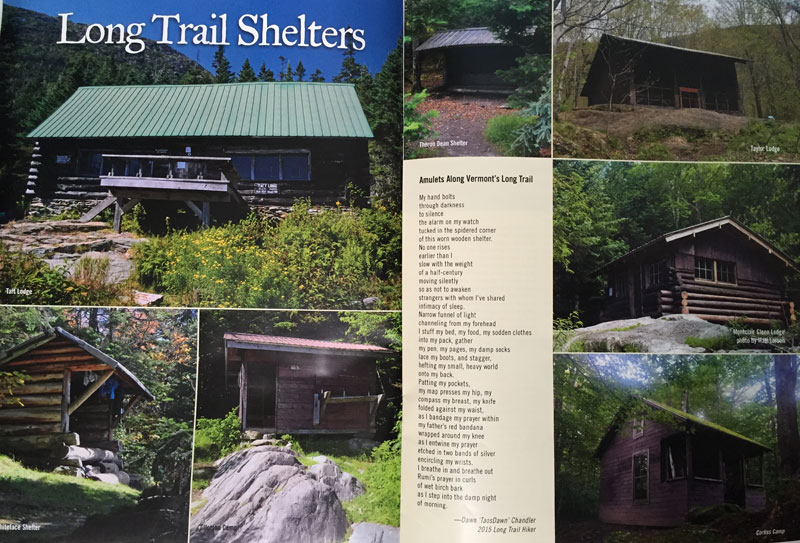 Upon the page these rustic structures sit like wise Buddhas, nestled among the trees. Some I know intimately from nights spent and meals had upon their plank floors. The one in the center on the far right is Montclair Glen — the last Long Trail shelter I laid eyes on, for it was there on September 27, 2015 where I limped off the trail. . . .
My eyes curved around the page . . . .
. . . and There was my name.
Upon the page these rustic structures sit like wise Buddhas, nestled among the trees. Some I know intimately from nights spent and meals had upon their plank floors. The one in the center on the far right is Montclair Glen — the last Long Trail shelter I laid eyes on, for it was there on September 27, 2015 where I limped off the trail. . . .
My eyes curved around the page . . . .
. . . and There was my name.
 Above my name was a poem — my poem — one I’d written earlier this spring, and submitted on a whim to The Long Trail News.
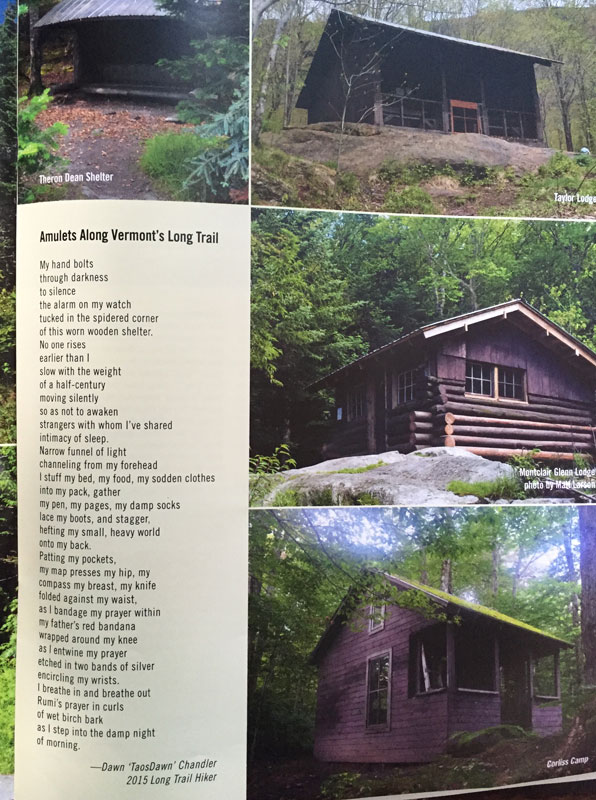 Amulets Along Vermont’s Long Trail
My hand bolts
through darkness
to silence
the alarm on my watch
tucked in the spidered corner
of this worn wooden shelter.
No one rises
earlier than I
slow with the weight
of a half-century
moving silently
so as not to awaken
strangers with whom I’ve shared
intimacy of sleep.
Narrow funnel of light
channeling from my forehead
I stuff my bed, my food, my sodden clothes
into my pack, gather
my pen, my pages, my damp socks
lace my boots, and stagger,
hefting my small, heavy world
onto my back.
Patting my pockets,
my map presses my hip, my
compass my breast, my knife
folded against my waist,
as I bandage my prayer within
my father’s red bandana
wrapped around my knee
as I entwine my prayer
etched in two bands of silver
encircling my wrists.
I breathe in and breathe out
Rumi’s prayer in curls
of wet birch bark
as I step into the damp night
of morning.
by Dawn ‘TaosDawn’ Chandler
2015 Long Trail Hiker
Amulets Along Vermont’s Long Trail
My hand bolts
through darkness
to silence
the alarm on my watch
tucked in the spidered corner
of this worn wooden shelter.
No one rises
earlier than I
slow with the weight
of a half-century
moving silently
so as not to awaken
strangers with whom I’ve shared
intimacy of sleep.
Narrow funnel of light
channeling from my forehead
I stuff my bed, my food, my sodden clothes
into my pack, gather
my pen, my pages, my damp socks
lace my boots, and stagger,
hefting my small, heavy world
onto my back.
Patting my pockets,
my map presses my hip, my
compass my breast, my knife
folded against my waist,
as I bandage my prayer within
my father’s red bandana
wrapped around my knee
as I entwine my prayer
etched in two bands of silver
encircling my wrists.
I breathe in and breathe out
Rumi’s prayer in curls
of wet birch bark
as I step into the damp night
of morning.
by Dawn ‘TaosDawn’ Chandler
2015 Long Trail Hiker
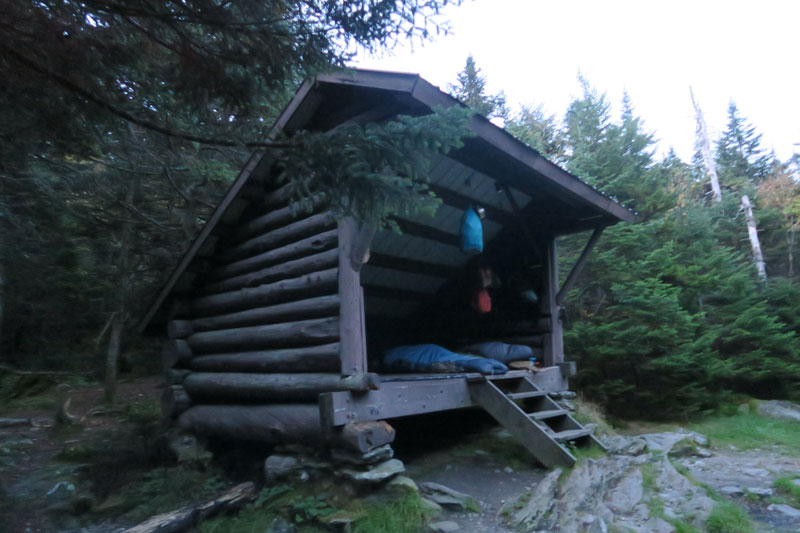
Early morning September 24 at Emily Proctor Shelter—Long Trail Mile 141. The photo belies the fact that it was close to darkness when I snapped this shot; Mowgli and JukeBox remain asleep. Per usual, they’ll soon pass me on the trail. Three days later I’ll come off the trail due to unbearably painful knees and quadriceps—but with a plan to return. . . . one day.
painting morning light on albuquerque’s la luz trail
When My Good Man revealed this weekend that he is on the “waiting list” for this year’s La Luz Trail Run, and that he wanted to do a training run up there this weekend, my painter’s mind started scheming.
My last plein air painting excursion was in early April. After an enthusiastic kickoff to plein air season with 12 paintings made in March and early April, I fell 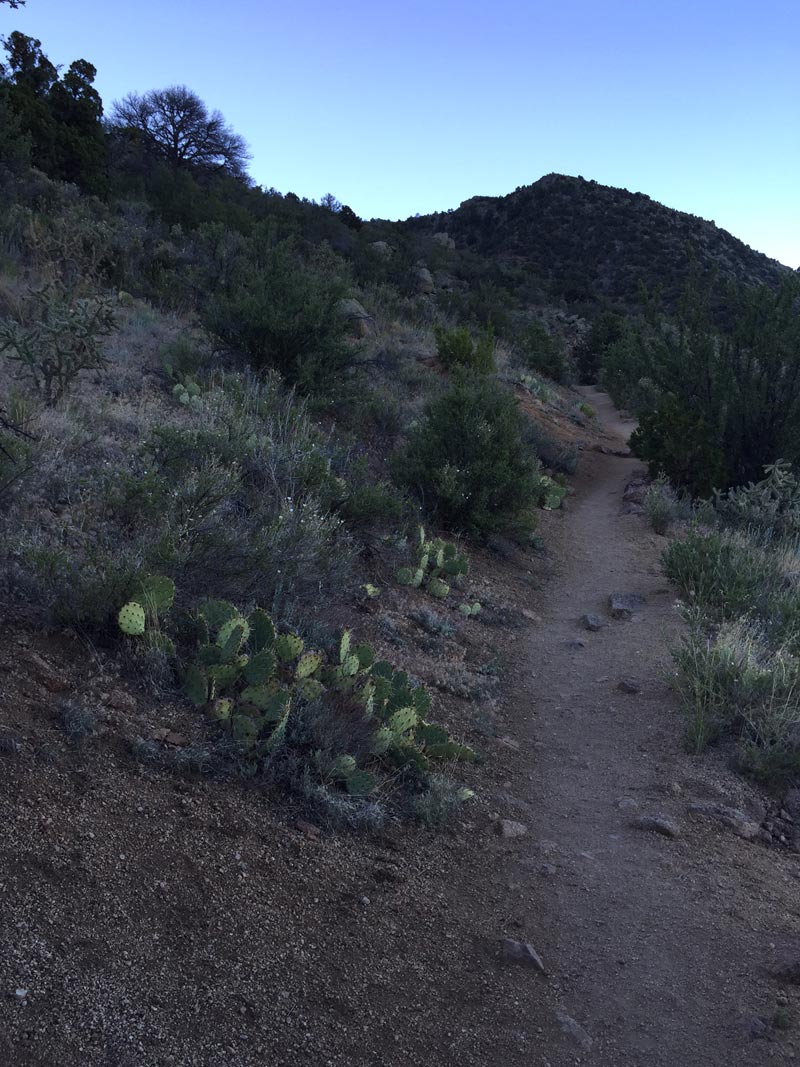 off to zero this month. ‘ Just got busy with other things. Busy with studio painting. Busy with computer work and the busy business of being an artist. But we’ve been having another unusually moist and green and gorgeous spring, and really it’s been frustrating that I haven’t been out painting it.
So there we were: 6:15 Sunday morning at the La Luz Trail. My Good Man took off running in shorts and a t-shirt and a plan to turn around in an hour and hike back down. I set off in my paint-spattered “man pants” (a pair of Orvis canvas men’s pants handed down from my brother and which I utterly love due to their supreme baggy comfort) + a raggedy paint-gungy sweatshirt + a broad-brimmed straw hat purchased on a blindingly sunny day at Ojo Caliente last summer + my small paint pack (as opposed to my large paint pack). [We left The Pup back home to enjoy a leisurely Sunday morning to herself. Much as we love to take her with us on our trail excursions, if one of us takes off ahead of the other, then she pulls on the leash fiercely and incessantly trying to bring us all together, making it most unpleasant for whoever is holding the leash.] My plan was to hike uphill for 15 minutes, find a spot to sit and try to pull together a painting before catching My Man on his descent a little while later.
Off he went, and off I followed. The morning was cool enough that, despite already wearing two layers, I threw in a wool sweater just in case I got chilled while sitting and painting.
Fifteen minutes later my phone alarm buzzed and, looking around, I spotted a great vantage point just above one of the switchbacks. Got comfy, opened my mini paint box and…. DAMNIT! No paint thinner in my little jar. Ugh. This meant I had no way to clean my brushes between colors, nor any way to moisten the stiff paint. Grrrrrrr. . . . My first plein air painting in weeks and already I’m off to an inauspicious start. Crap.
I was half tempted to just call it quits right then, but DANG IT! I really wanted to paint! So I decided to make due with stiff paint, and just wipe my brush with paper towels, which fortunately I had plenty of.
Of the three panels in my kit, I chose one that I had stained a dark purply-blue brown. As I’ve mentioned earlier, I usually stain my panels a warm orange. But if I know the scene is going to have a lot of deep shadows, sometimes I stain the panel dark. And being so early in the morning, most of the landscape was still in deep shadow, with the sun still low behind me and the Sandias.
Sometimes capturing a scene with paint is a real struggle. This morning though, despite lacking paint thinner, something just clicked. So much for inauspicious!
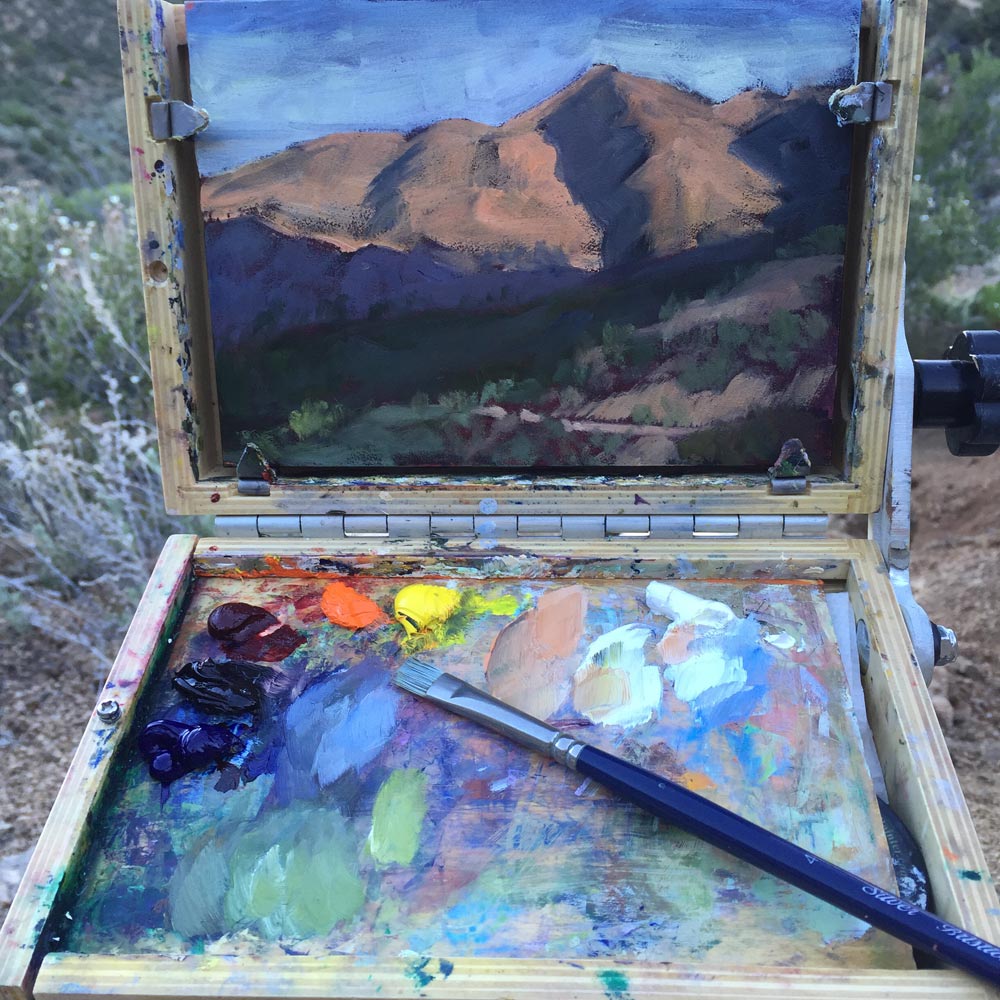
Okay. That was fun. And satisfying. And peaceful. And meditative. And it felt kind of sneaky, too, for as I sat there, at least a dozen hikers and runners passed not four yards from where I was sitting, yet I went completely unnoticed. ‘felt like I was getting away with something.
Indeed, I enjoyed myself so much, and so reveled in the light and color and refreshing coolness of the early morning trail that I decided to do it all over again the next day.
Monday morning 6:45, armed with coffee and my trusty sidekick whining in the backseat with barely bridled anticipation, I turned off Tramway Blvd. onto Forest Service Road 333. With an 8:30 appointment to meet a friend for breakfast at Flying Star, I was feeling a little pressed for time and wondered if the La Luz Trail was realistic.
No, it wasn’t.
Rather, I took the first right up to La Cueva Picnic Site — some place I’d never been, having only learned about it the day before from a USFS elder volunteer, who described it as “underused.” I’d say that’s an understatement, for The Pup and I had the place to ourselves and— AND!—we saw not one speck of trash nor bit of graffiti.
Incidentally, the pay fee here and at La Luz is $3. But because it’s Federal land, my handy America the Beautiful National Park Pass gets us in. Best, most worthwhile $80 you’ll spend all year. Get one.
A scramble up an unmarked trail, and soon we found ourselves perched on a rock above the morning city.
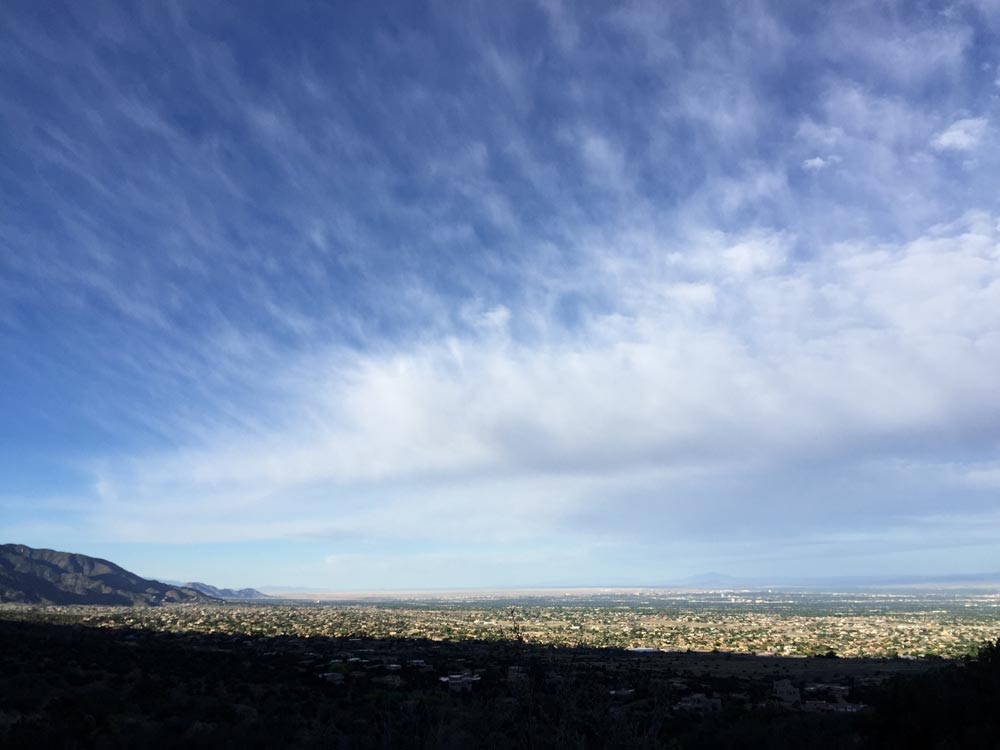
Once again we were hidden just a few yards from a trail, and once again we went completely unnoticed by hikers. The Pup seems to know the game of stealth, and knows to sit alert and still, watching quietly as the hikers walk by.
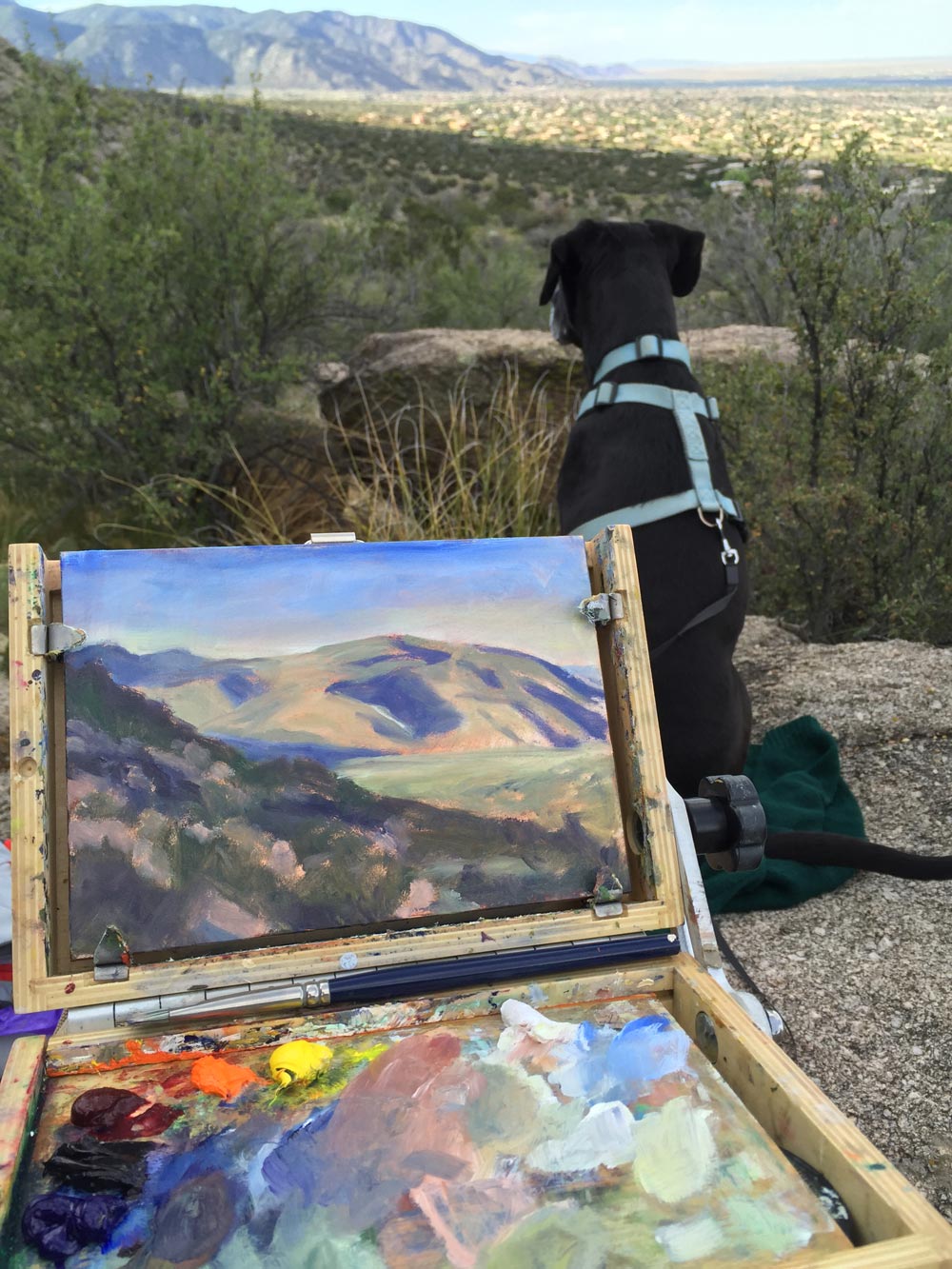
Two perfect mornings in a row. You can be sure we’ll be coming back.
And next time I may just purposefully leave my paint thinner at home!
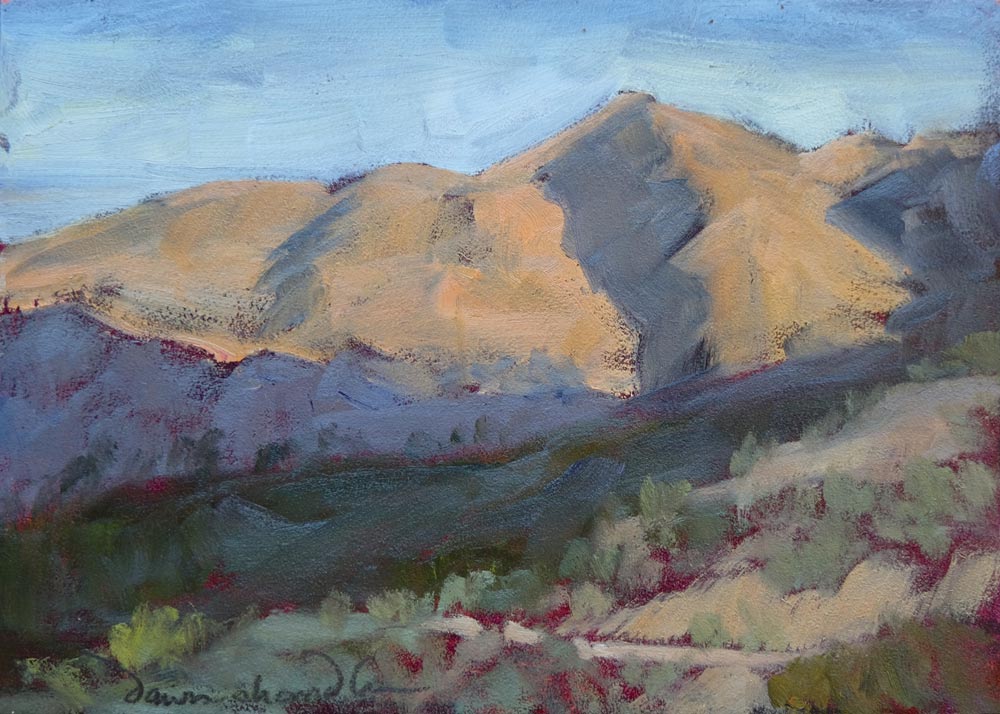
early morning light from a luz trail ~ by dawn chandler ~ oil on panel ~ 5″ x 7″ ~ en plein air
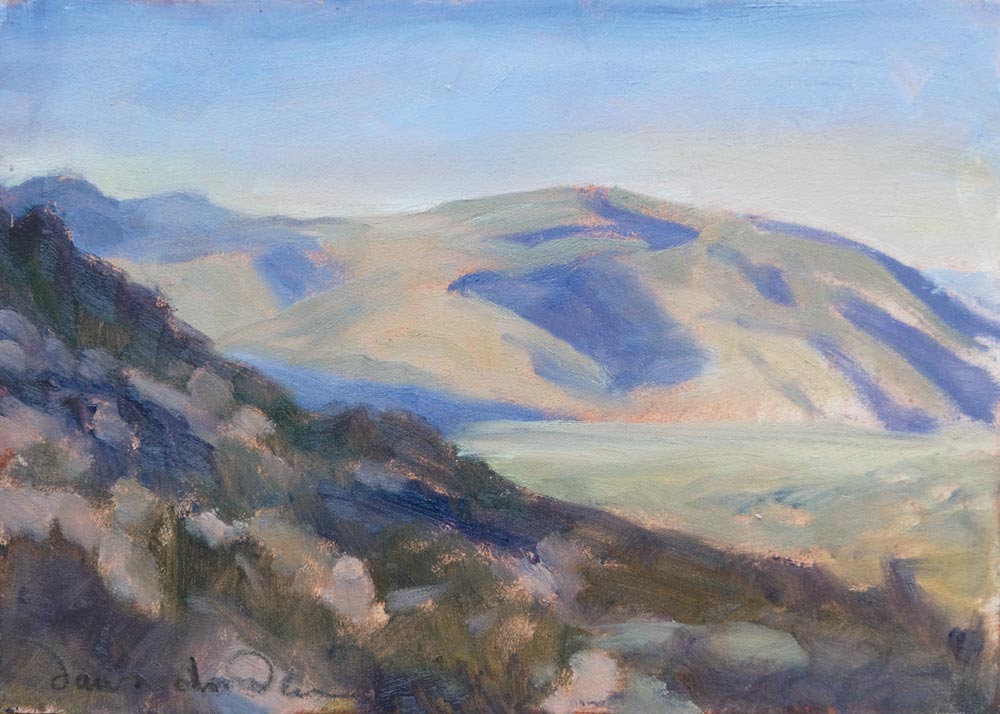
morning across albuquerque from la cueva ~ by dawn chandler ~ oil on panel ~ 5″ x 7″ ~ en plein air
how vermont trees lead back to new mexico sky
 When I set out last year to walk across Vermont, one of my plans was to create a body of paintings based on my hike. They would be in the style of my “textual landscapes’ where I combine language (text) with semi-abstract landscape elements. The text might come from my Long Trail diary. If I were lucky, maybe I could even secure a 2016 residency at the Vermont Studio Center in Johnson, VT, and develop these paintings there, just a few miles from The Trail.
So much of last year was spend getting ready for my Long Trail hike. Hours and miles of spring and summer getting my body used to walking with weight; still more hours researching, planning, gathering and testing supplies and food and equipment. Painting focus was withdrawn. When I was able to paint in my studio, I worked small: 6” x 6” and 6” x 12” and 8” x 8” — panels small enough for me to get my head around in short bursts of time. Small enough, too, to hold in my hand and not take up too much space as piles of food and gear expanded from the closet tucked under the stairs and out into my studio. Rarely during this time did I finish a painting; mostly, they were incomplete.
In late summer as I packed up my gear and readied for my journey, one of my last actions at home before heading off to Vermont was cleaning my studio: I put away all the backpacking gear I was not taking, tidied table tops, arranged pens and brushes and paints and panels so that all of these would be in good order when I returned seven weeks later. And all of those unfinished paintings I hung on the wall in a neat grid.
And then deep into the Vermont woods I went.

You who are well acquainted with New England mountains will laugh, but here’s what I didn’t really grasp about Vermont until I attempted to walk across it:
Vermont is 80% wooded.
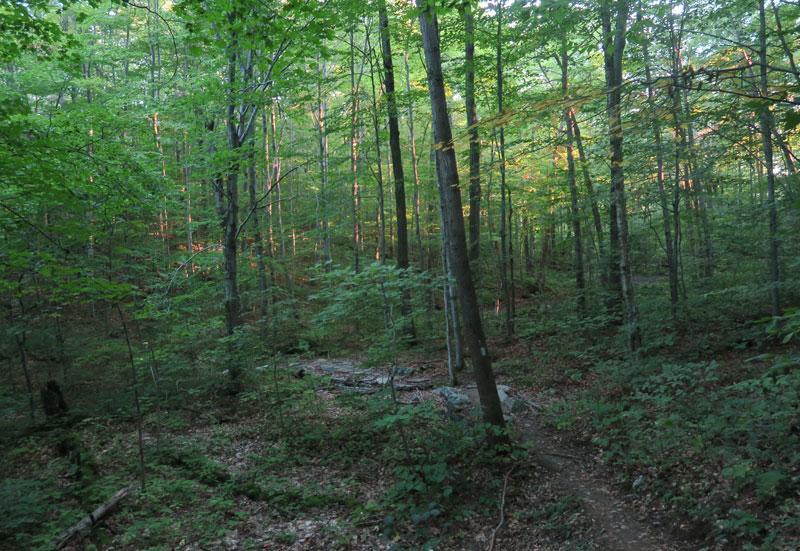
The Long Trail then is, as one fellow Trail veteran put it, “A long walk through the trees.”
Even the mountain tops!
This was a surprise to me. To slog up…. up…. up…. up…. and… finally… reach.. .the… summit… and… look out… and… see..
TREES!
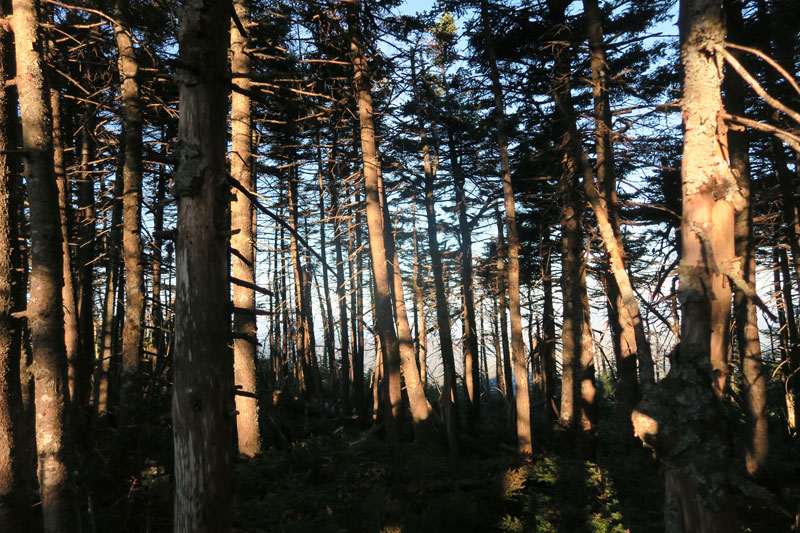
I am so entirely conditioned and spoiled by the trails of New Mexico and Colorado, where, for the most part if you hike up a mountain, when you reach the top, you’re rewarded with a BIG VISTA PAYOFF.
But not in Vermont. At least not on most of the mountains in the first 174 miles of The Long Trail.*
Some of the peaks have fire towers. Others have ski areas, where swaths of trees have been cleared to make ski runs. In fact, if ever I was able to get a sweeping view of the landscape around me, it usually was from the summit of a ski area.
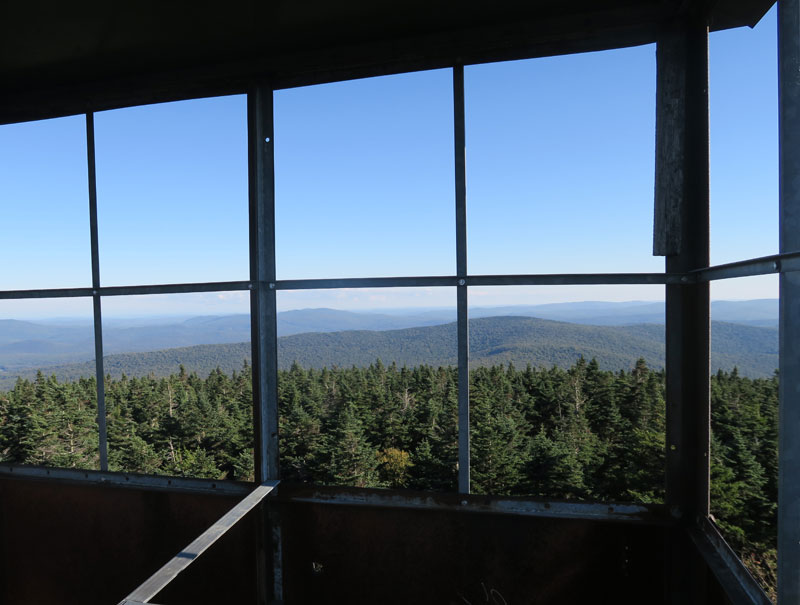
Afternoon view from the Glastonbury Mountain fire tower
Mostly though, my walk through Vermont was very much a walk through the trees; little blue sky was revealed to me. And when it was, often it was obscured by mist.
What’s funny though is that I never thought of myself as a “sky seeker.”
Then I returned home to New Mexico, and walked into my studio, and found myself. . .

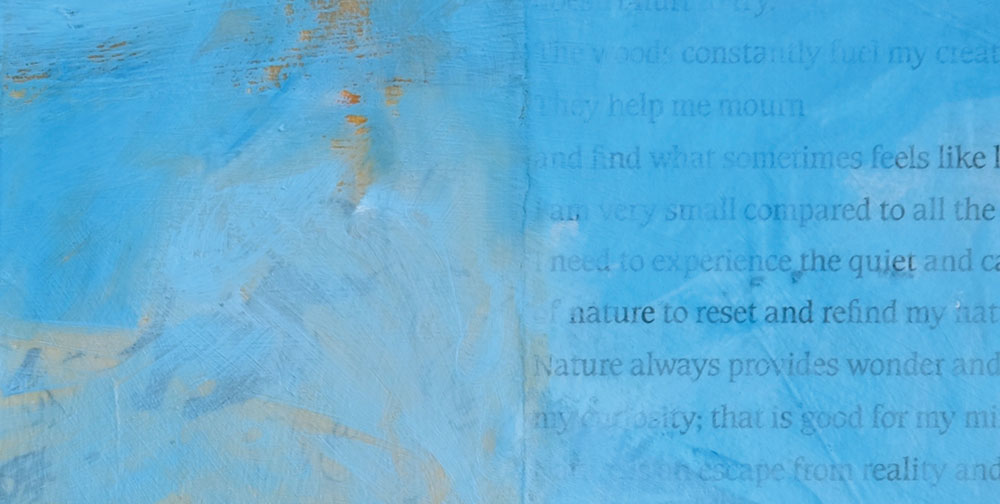
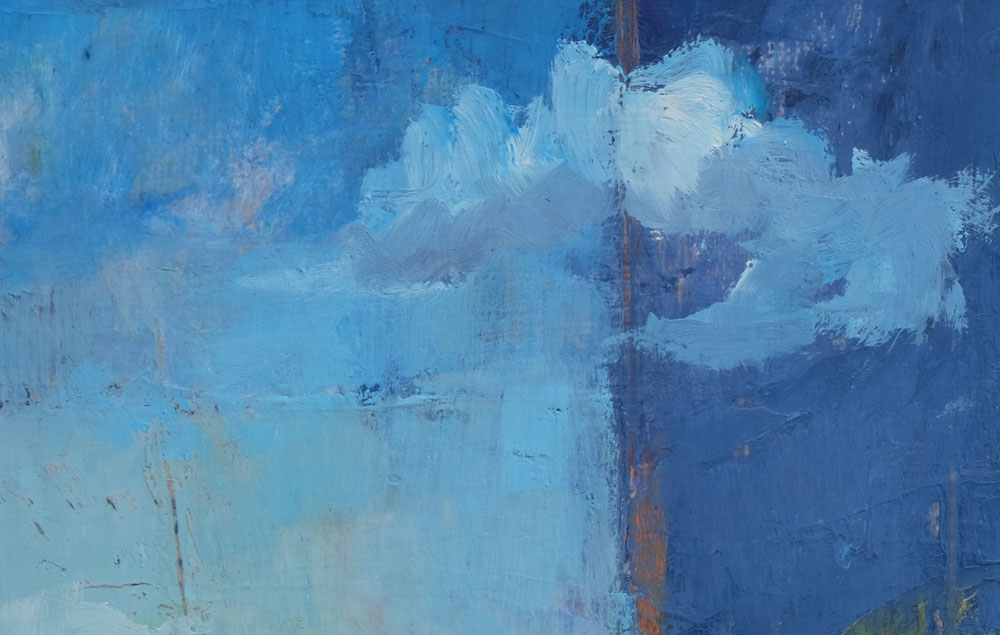
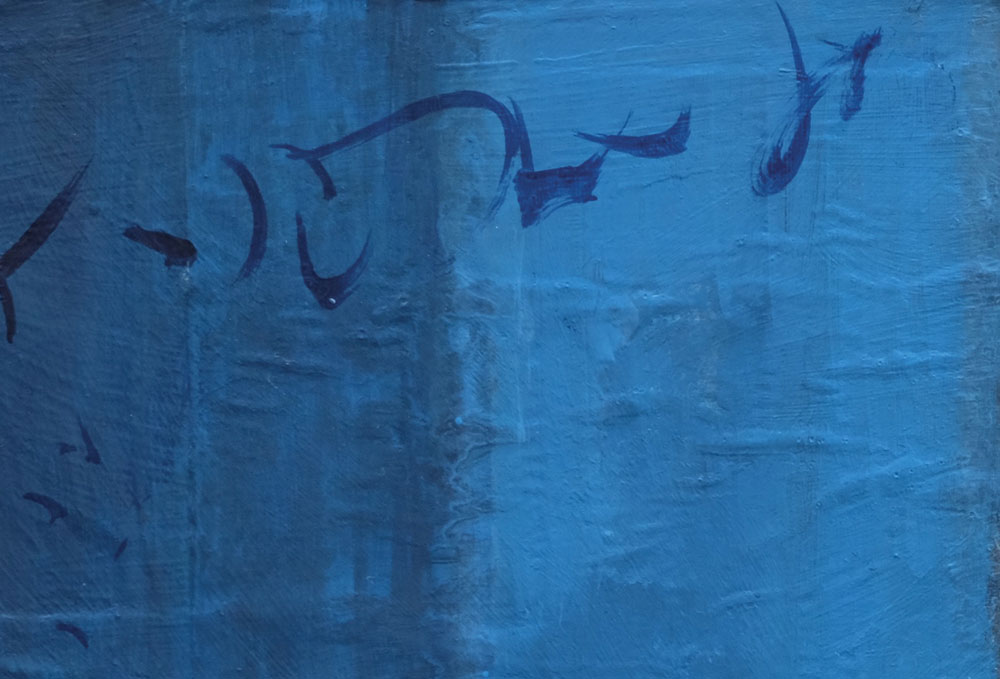
. . . surrounded by sky.
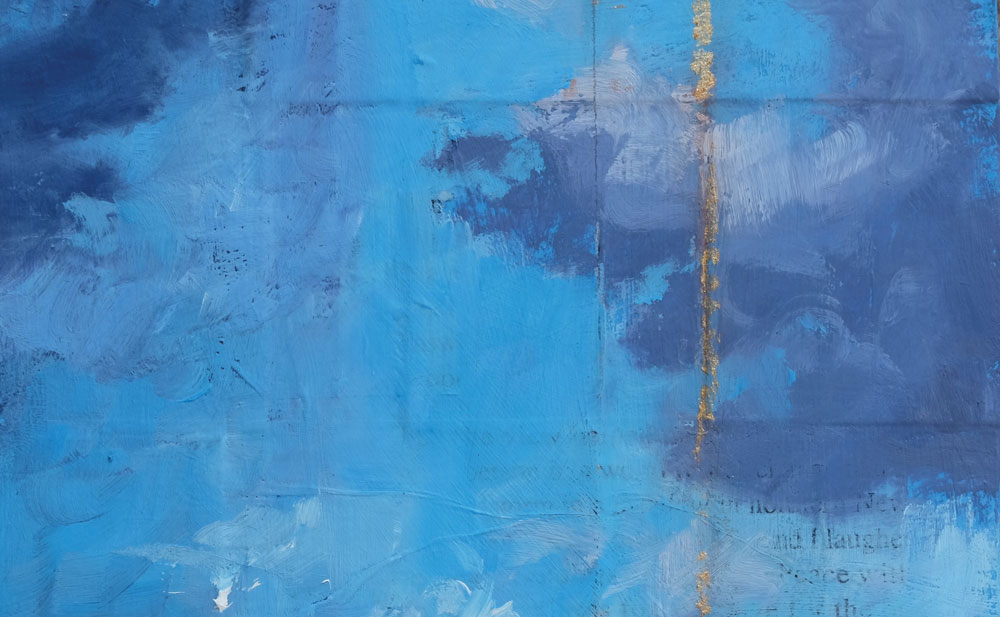
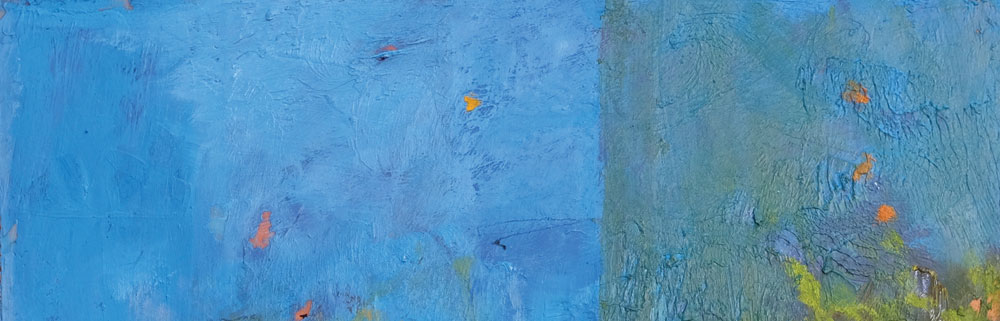
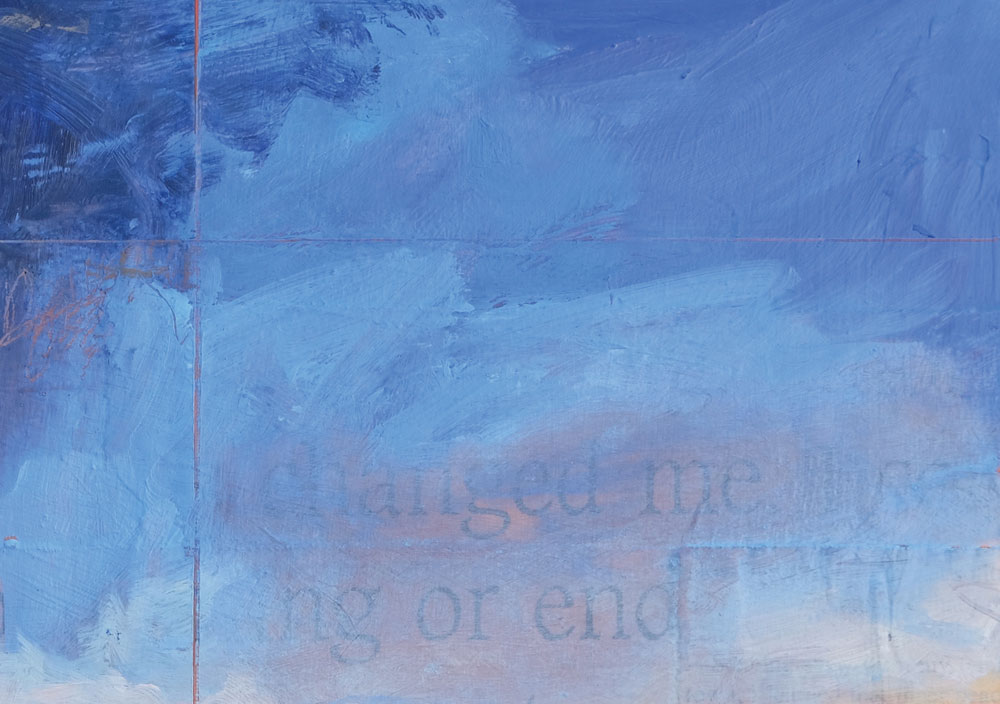
Nearly every painting in my studio seemed to be of sky. Even those tiny unfinished 6” x 6” panels expressed B I G expansive S K Y.
It nearly knocked me over the abundance of sky — especially BIG BLUE SKY — in my studio.
And what I realized then is that even though I had just walked through the forest, I wasn’t ready to paint it.
Rather, I was ready to paint the sky. Hungry to paint it.
And so I set about doing just that: finishing all those little panels I had started last spring.
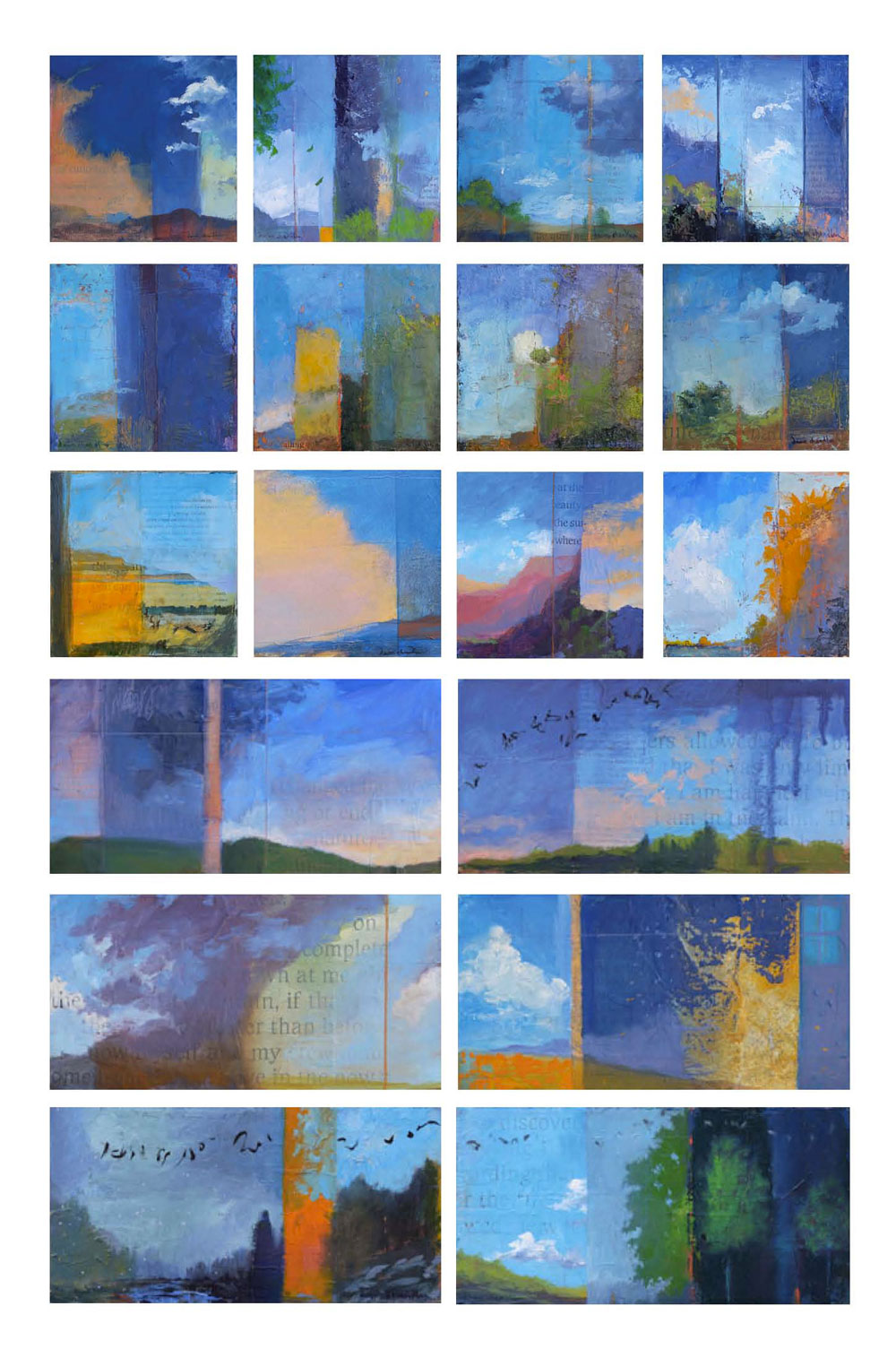
I do still plan on creating that series on the Vermont woods.
But those paintings are going to have to wait until I finish walking that last 100 miles through the trees.
Meanwhile, I’ve found my path to the sky.
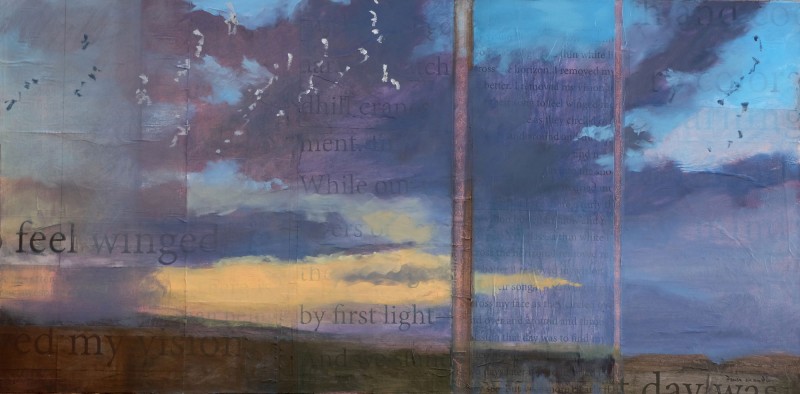
feel winged ~ oil and mixed media ~ 24″ x 48″
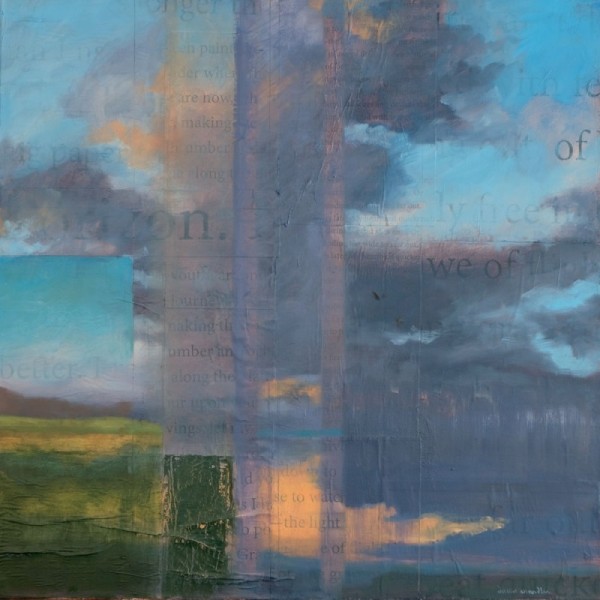
your journey ~ oil and mixed media ~ 24″ x 24″
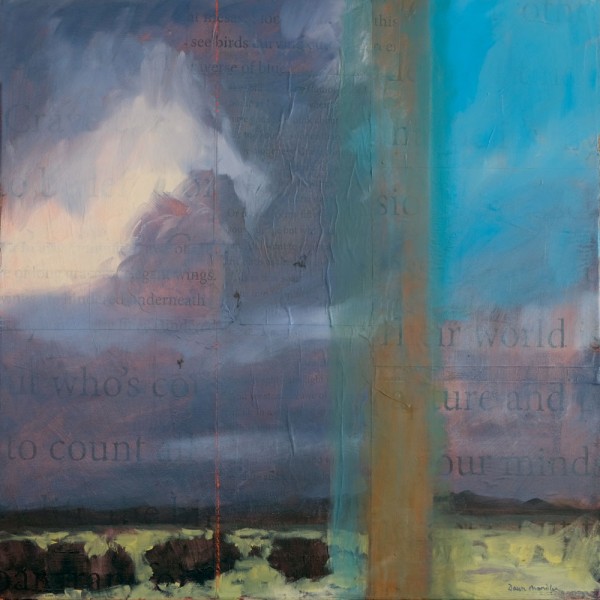
see and stand in awe ~ oil and mixed media ~ 24″ x 24″
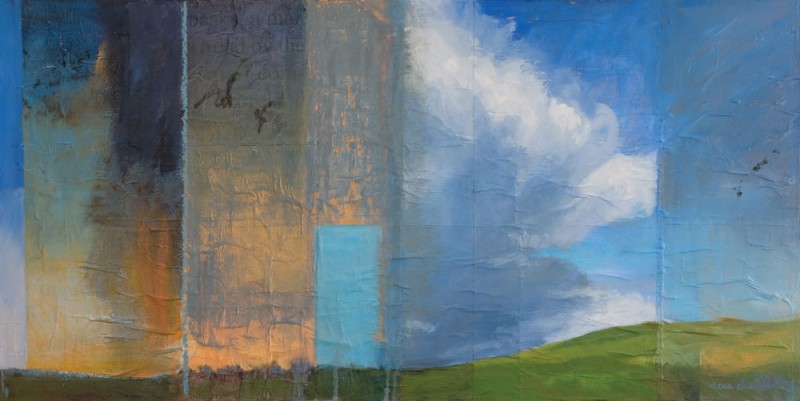
we were speaking of summer ~ oil and mixed media ~ 24″ x 48″
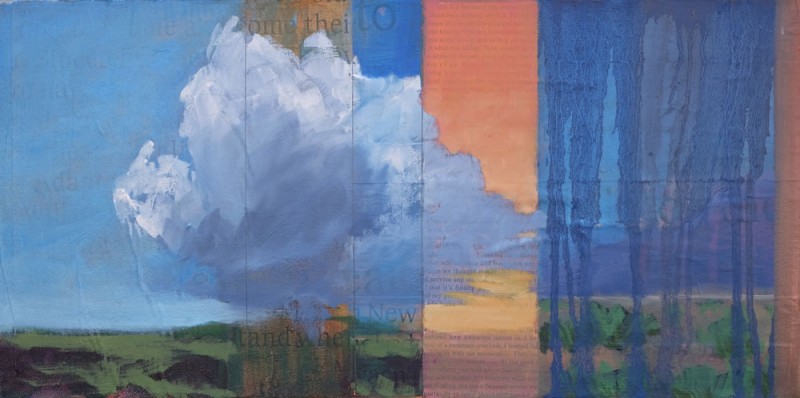
i learned how awesome nature is ~ oil and mixed media ~ 10″ x 20″
_____________
*I have yet to hike from Camel’s Hump northward, across the Mount Mansfield region, whose peaks most certainly do rise above timberline. Indeed, those views are one of the several reasons why I’m determined to return to the trail next year and finish out my last 100 miles….
how a landscape painting evolves
It’s always a little amazing to me how a landscape painting evolves. Even though I’m intimately aware of the stages, it still surprises me every time when, in the end, I have something I can actually recognize and identify. Between the first dabs of paint and my final, victorious signature, there’s a whole lot of mess and doubt and wonder. Yet almost in spite of myself, in the end somehow it all comes together.
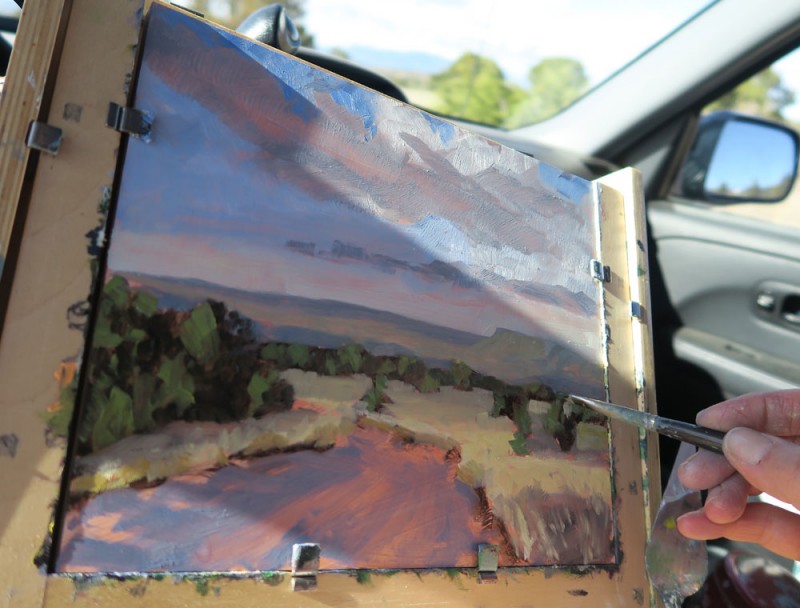
Here are the steps of a plein air painting I did last week out at the Galisteo Basin — a beautiful sweep of southwestern beauty about 15 miles south of Santa Fe. Midweek I drove out just after sunrise. ‘Took the Pup for a nice little hike, then from the front seat of my car, found a good vantage point to observe a sweet vista of fast moving clouds and endlessly shifting light.
[Apologies for some of the awkwardly angled photos, but it’s a bit cramped in my car, and my focus, of course, was on painting, not so much on getting well composed-photos. Hopefully they’re good enough to get a sense of the painting process, at least.]
My palette, clockwise from the bottom left:
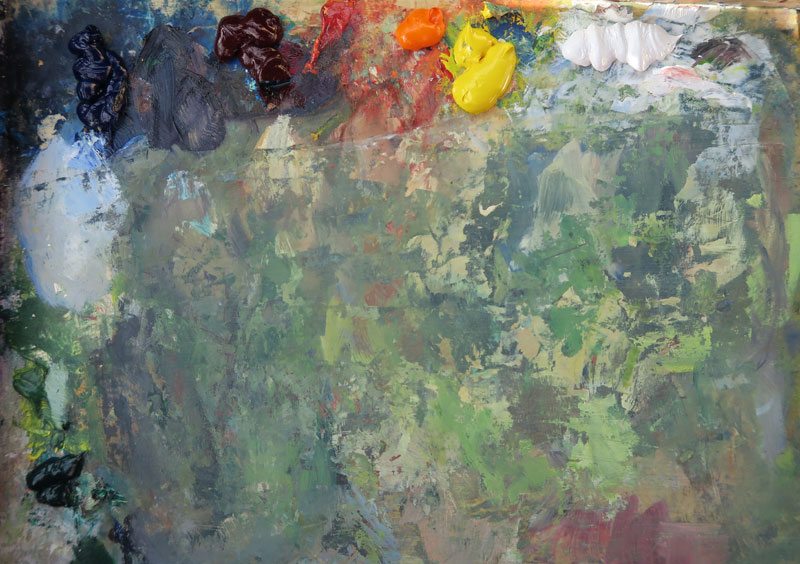
— windsor green (intensely strong; I’ll use this very minimally)
— green* mixed with ultramarine blue and hansa yellow (I’ll mix a lot more of this before I’m done)
— ultramarine blue (upper left corner)
— purple* mixed ultramarine blue and alizarin crimson
— alizarin crimson
— a bit of cadmium red light
— cadmium orange (this is to save time. I can get a color very close to this by simply mixing cadmium red light with hansa yellow, but I had a tube of cad orange, so I’m using it.)
— hansa yellow
— titanium white (I’m always amazed when plein air painting how much white I consume. Tons of it).
*If I think of it, I like to mix these colors in my studio, so as to save time once I’m out in the field, as the light and colors can change so quickly.
This is a more varied palette than I usually use in the field. Often I aim to use a “minimal palette” of just 4 colors — ultramarine blue, alizarin crimson, hansa yellow and titanium white. But I’ve been wanting to play with a bit more variety of colors, so have added a couple more.
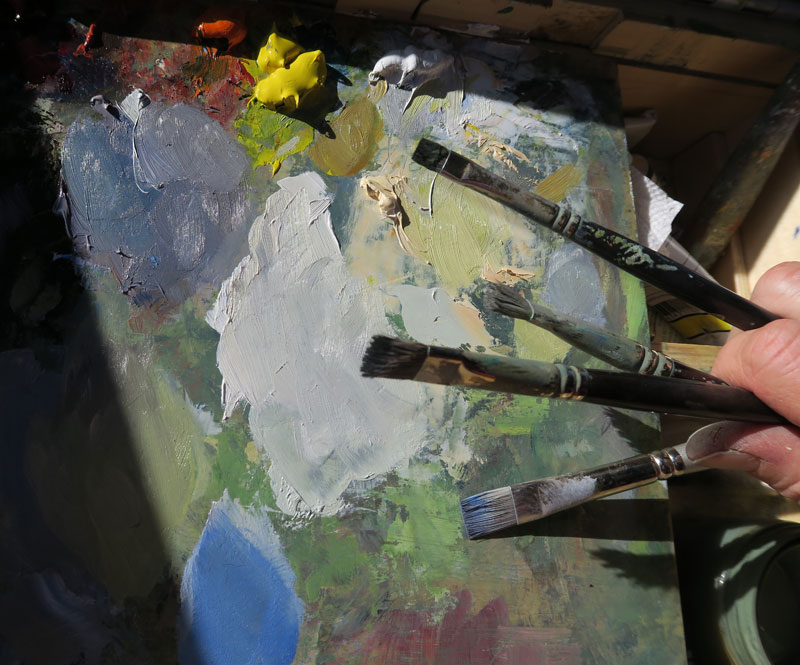
Below, some of the brushes I used today. The largest one is a #6 “bright” — essentially a flat, compact brush with the toe end of the bristles forming a straight edge, and the belly of the brush about 1/2″ wide.
Note the colors mixed on the palette. At this point I was working on the lightest elements of the painting, namely the sky and highlights of the grasses — but that’s jumping ahead.
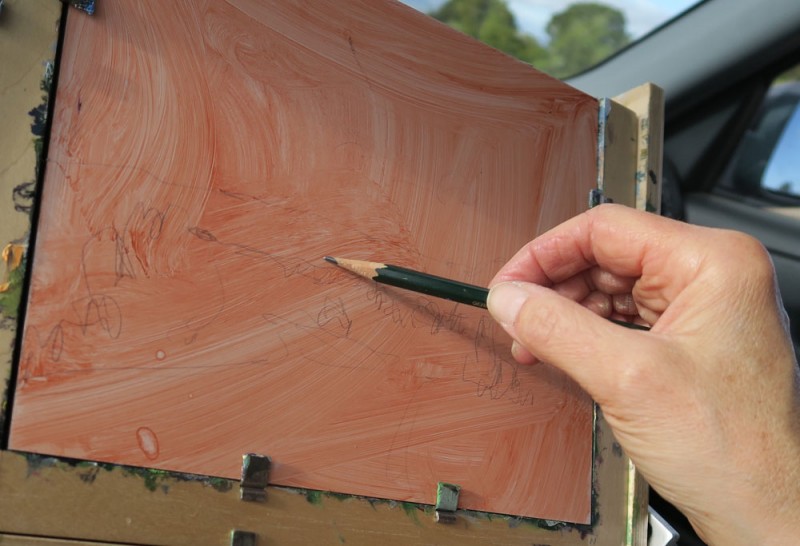
The first step in my creation of a traditional landscape painting is done back in the studio, where I stain the panel a warm orange-brown. I do this partly because the white surface is intimidating in its purity and brightness. More important, I do it because so much of my New Mexico landscapes are made up of blue (sky). Orange is the opposite of blue; they are compliments. So when I paint blue sky over orange, the orange makes the blue sing with vibrancy. Moreover, staining the panel orange-brown adds warmth and cohesion to the overall painting, as little flecks of it will appear here and there in the final painting.
Out in the field though, my first step after arranging my gear is to do a quick loose sketch to organize my perception into a composition. Note how I’m holding the pencil — this helps keep my marks loose and gestural, without getting caught up in needling details.
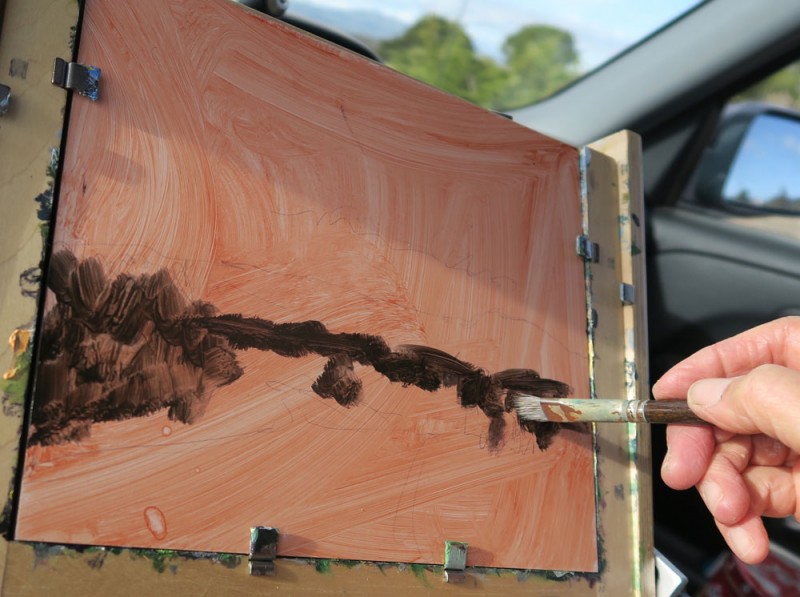
Then, I figure out where the “darkest darks” are, and block those in with the darkest mixture I can muster — some variation of my darkest paints all mixed together — usually ultramarine blue mixed with alizarin crimson mixed with windsor green with a touch of yellow
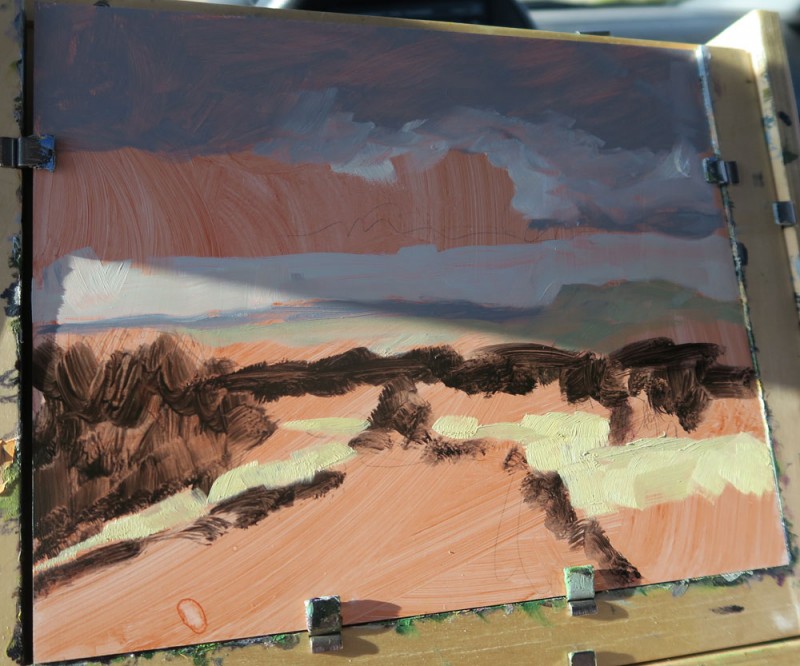
Next, I block in the “lightest lights” — in this case the dry winter grasses radiant with sunlight and also the far distant sky — then on to the distant mesas, trying to capture that certain shade of faraway green.
Incidentally, this business of blocking in the “darkest darks” first followed by the “lightest lights” I picked up from master painter Kevin MacPherson’s excellent book Fill Your Oil Paintings with Light and Color.

Then onto the sky. When I started this painting, the sky overhead was consumed in a massive grey cloud bank. All the while I was painting it was churning:
Punching in some blue to the sky. Already that massive cloud had lightened and is starting to change shape and break up:
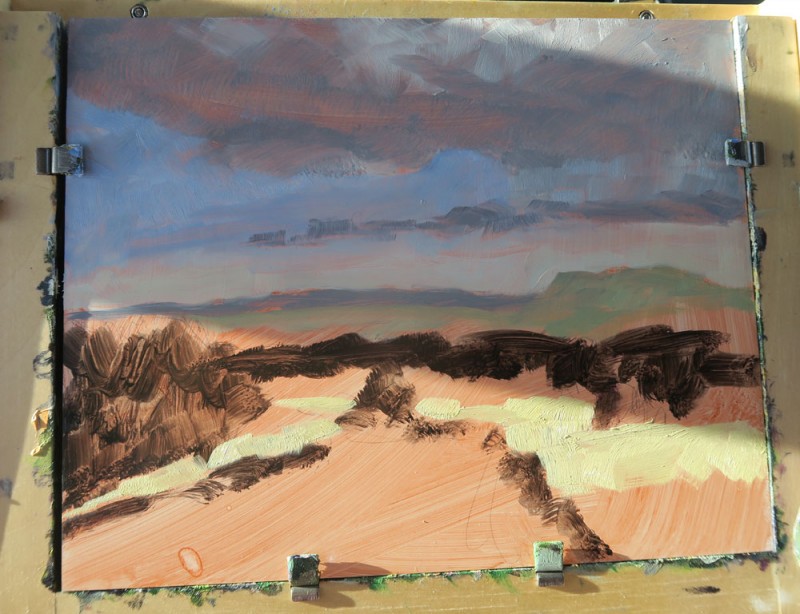
Adding some color to the foreground, including the road.
A wad of paper towel is as important a tool for me as a brush. I used it to pick up some of the paint in the cloud bank and now here, to soften the strokes in the foreground:
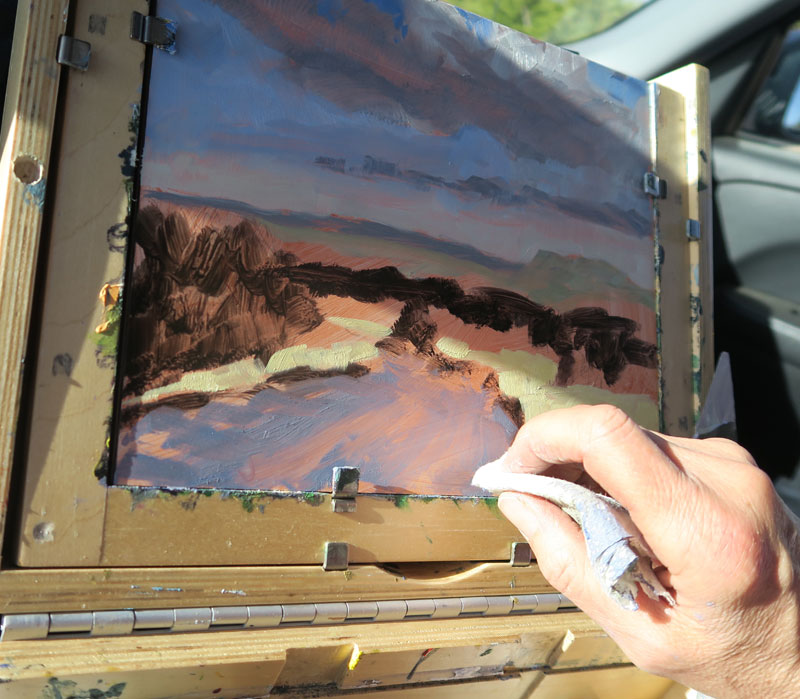
Now to go in with green, and start adding a sense of the light hitting the junipers. I always find this challenging. I’ve learned that it really helps when you lay the darks down first, then “paint to the light.” For some reason that works much better than going the opposite direction of light -> dark.
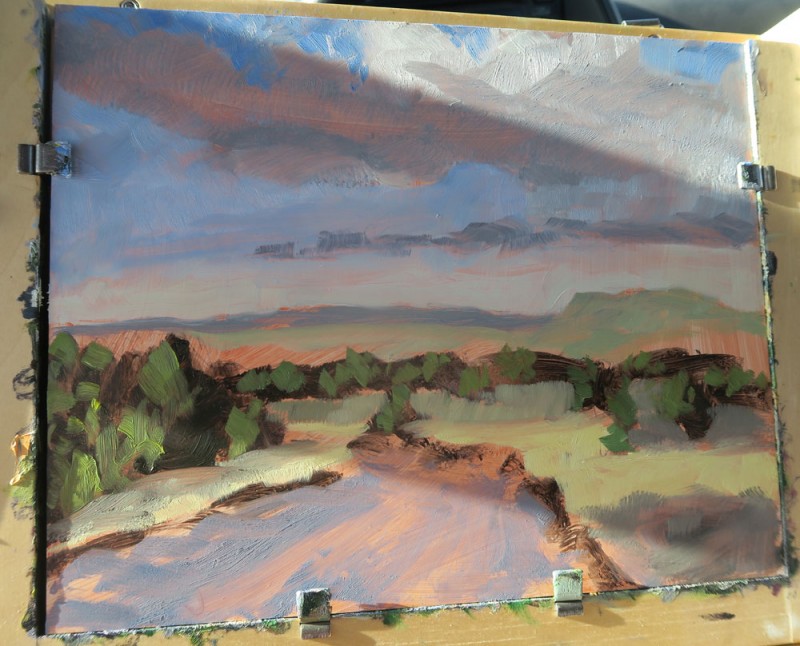
Note the difference in overall color between the image above — where direct sunlight is hitting my easel — and the image below, where a cloud has moved in. Notice a difference?
The one above has the glare of bright sunlight as well as a harsh shadow from the car window frame.
In the image below — where my whole easel in in shadow — the overall painting is much, much cooler and bluer.
Which is the true color? That in the sunlight or that in the shadow?
Therein lies the challenge of painting en plein air.
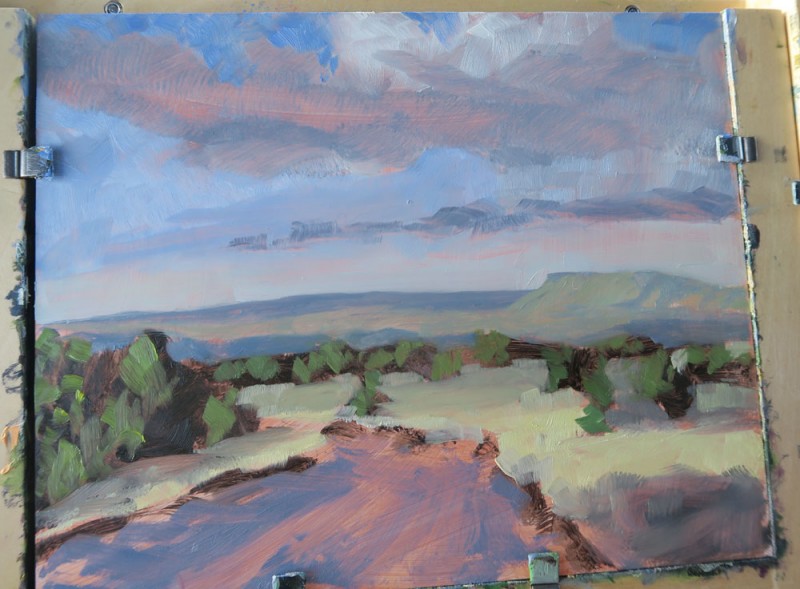
Softening some of the shadows and adding a few highlights and a little more detail:
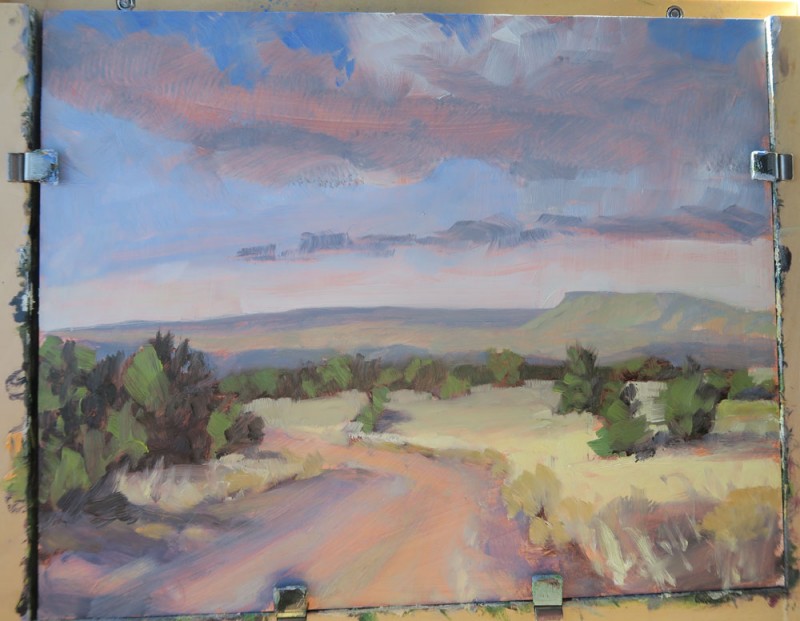
The clouds have continued to change; below, I update them with a little more shadow and highlights.
The mid-ground looks a little too smooth, so I add some quick marks to suggest cholla cacti, which are abundant out here.
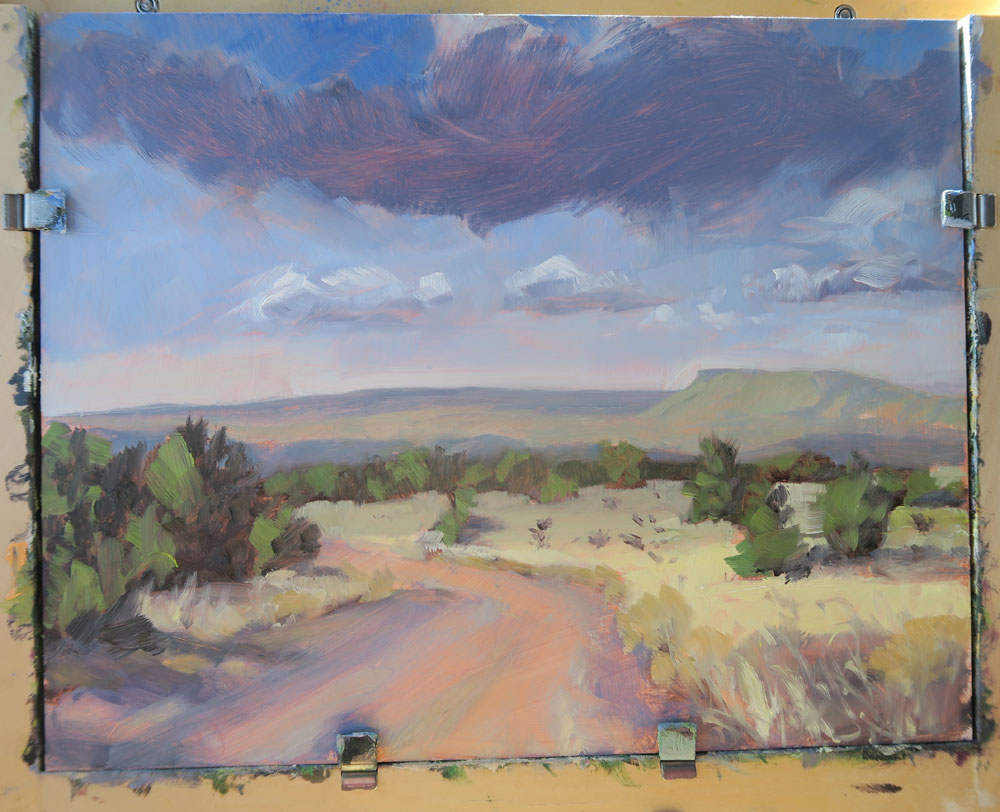
Deem it finished and scrawl my signature with a pencil, etching it into the wet paint.
Total time: about 40 minutes, give or take, which includes occasional interruptions from someone in the back seat.

And yes — this painting is for sale. 🙂 Buy it here — though note it won’t be ready to be shipped for a few weeks yet, to allow the paint to dry fully.
jumping off and leaping in
I guess it was my turn.
My turn to have a crappy week…or two.
Let’s face it: I lead a pretty charmed life. I’m self-employed doing what I love; I’m active and in good health (I haven’t had a cold in five years); I’m reasonably financially secure; I live in desired solitude in a beautiful, soulful part of the world . I have no dependents, so I’m able to wake up quietly each morning and make each day my own. I’m blessed with a Good Man, a Good Pup, a big circle of friends, and come from a family that I’m infinitely proud and fond of. My “problems” are minuscule to nonexistent compared to what some people have to deal with, maybe even most people. In general, I believe in the power of a positive outlook on Life and therefore strive to make the most of what comes my way, so maybe that’s helped to bring grace to my life. Who knows.
Having a positive outlook though has been harder to maintain these past couple of weeks.
Mid-February I returned home from a midwinter trip with the plan of immersing myself in my studio. My calendar was wide open and I could spend two whole weeks with no distraction. I even had it on my calendar: A block of days with STUDIO written in bold across each day.
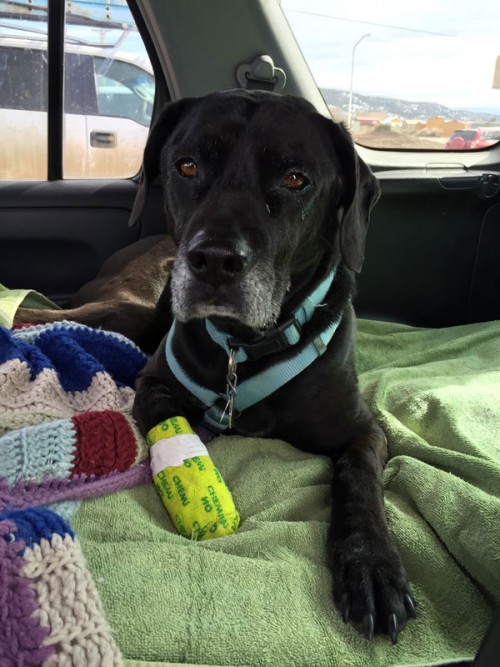
Wilson Pupster a bit groggy after paw surgery
Yet within 24 hours of returning from my travels, my Pup needed surgery. Within 24 hours of that, my utility closet—home to my hot water heater and furnace—in my kitchen started flooding with water, as did my neighbor’s (we share a wall). Now we are going into week three of mold eradication and repair.
This, of course, was the perfect time for the “check engine” light of my car to come on.
And what better time to get bulldozed by one helluva nasty head cold—my first in half a decade?
Couple all of this with the nauseating political shenanigans going on in our country and it was all I could do to crawl out of bed this past Monday morning.
Having had to vacate my place while the mold work was being done, I had camped out for several days at My Good Man’s place in ABQ, where I mainly coughed and sniffled and whimpered through sleepless nights while phlegm slugged down the back of my throat and my head expanded within the clamp of a vice grip. Exhausted, frustrated and a bit disgusted with myself as well as the world, Monday morning came and I didn’t feel particularly grateful for the “extra” day of February.
A message in my InBox from Seth Godin reminded me it was “Leap Day,” and the importance of taking leaps in one’s life and one’s career.
Whatever.
I shuffled along hacking and packing up my things. Arranging stuff in my car I shoved aside my massive LLBean canvas tote containing my plein air paint kit. I’ve been hauling it around all winter, thinking I might pull over somewhere here or there and knock out a quick painting.
So far?
Nothing.
I haven’t done a single plein air painting since August.
The voice that put the kit in my car weeks ago had said ‘get to it’ while another voice heavy with laziness countered every time with ….you don’t have time…it’s too cold….wait until spring….there’ll be more color…
In other words, put it off.
UGH. My head was pounding. I was in no mood to hit the highway and drive I-25 home to Santa Fe during Monday morning rush hour.
But Seth’s words nagged at me:
Leaping powers innovation, it is the engine….of a thrilling and generous life.
Of course, you can (and should) be leaping regularly. Like bathing, leaping is a practice, something that never gets old, and is best done repeatedly.
And it occurred to me, I should take the back way home….and paint along the way.
Screw waiting until spring. I should just do it. Leap in now.
The “back way home” is Route 14 along the historic and storied Turquoise Trail . I don’t know why I hardly ever go that route. I suppose because it’s a little slower and so a little longer. It’s also a whole lot more pretty and interesting than the Interstate, and has hardly any traffic this time of year. And—AND—there’s not one but TWO decent coffee stops: one in the village of Cedar Crest and one in the funky art hamlet of Madrid.
My Pup and I piled into my car and I drove.
An hour later as I sat sipping good coffee and twirling my brushes, my Pup asleep near me in the back of my car, the morning sunlight of a weirdly mild February warming us both along this peaceful stretch of New Mexico blue highway, all concern of my “problems” evaporated.
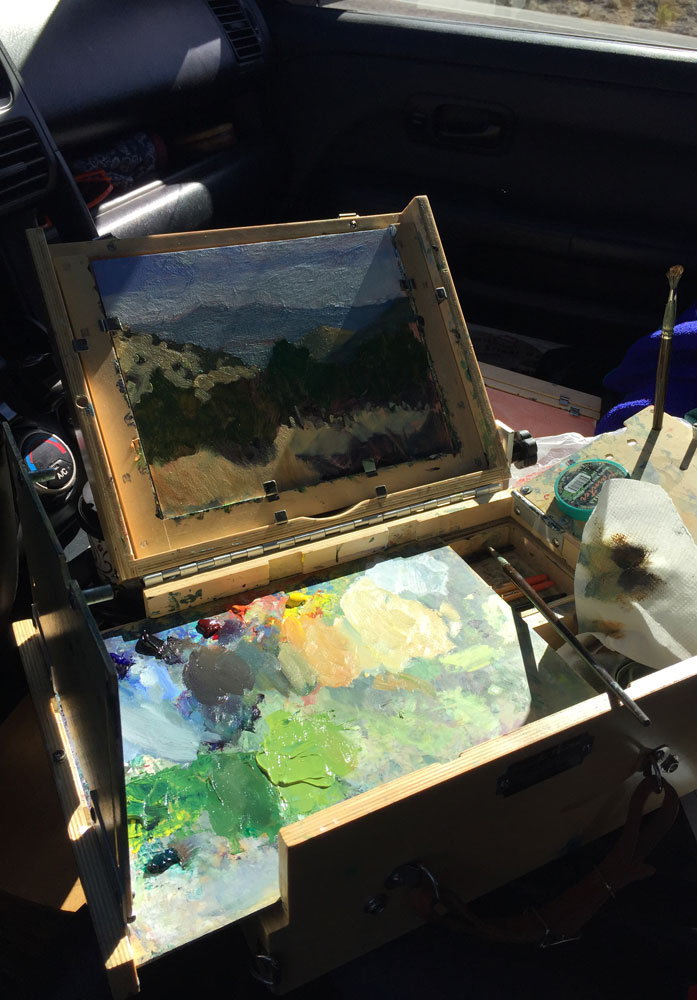
And I thought why the hell don’t I do this more often?
Too often I resist the urge to go out and paint en plein air because…. because…. because…. I don’t know why.
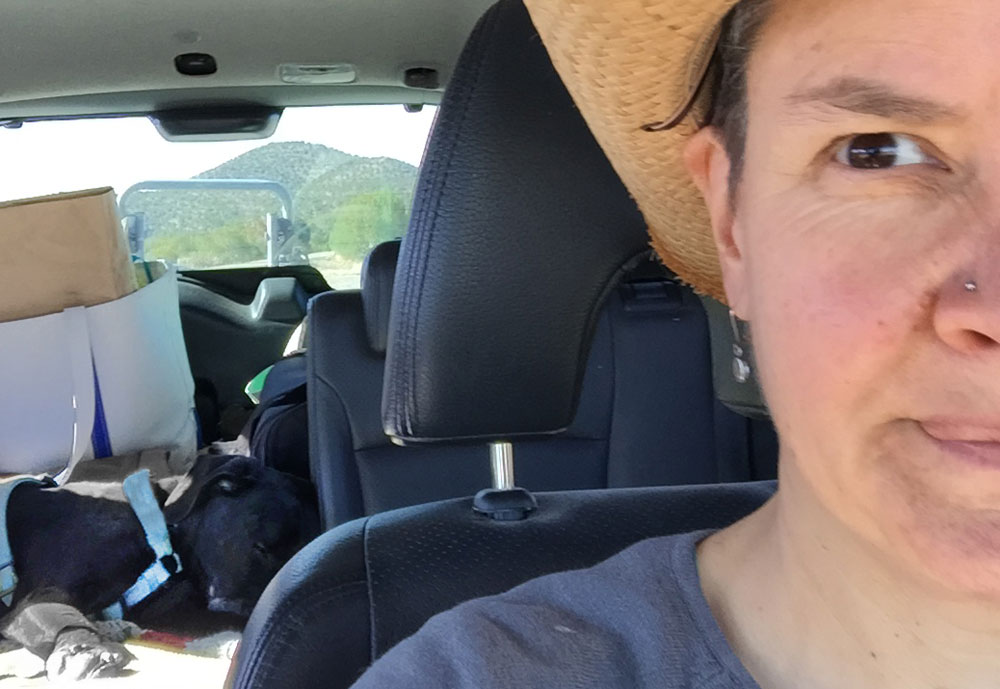
best to let sleeping dogs lie….
Because it’s a little bit of a hassle?
Because it involves time? a little bit of planning? and the arrangement of my stuff and inevitably getting paint all over me and my hands and just about everything I look at?
Because it’s actually really kind of fun and so doesn’t feel like work, and I’m constantly beating myself that I need to be working?
But that makes no sense because ALL the art-making I do—whether plein air or in my studio—is pretty much fun.
Bottom line?
ALL lame.
I think mainly it just comes down to making the decision to do it, to take the leap. To plan ahead, get all your gear together in advance and get in your car and drive. And then pull over, pull out your paint box, nuzzle your pooch, take a swig of coffee and leap into painting.
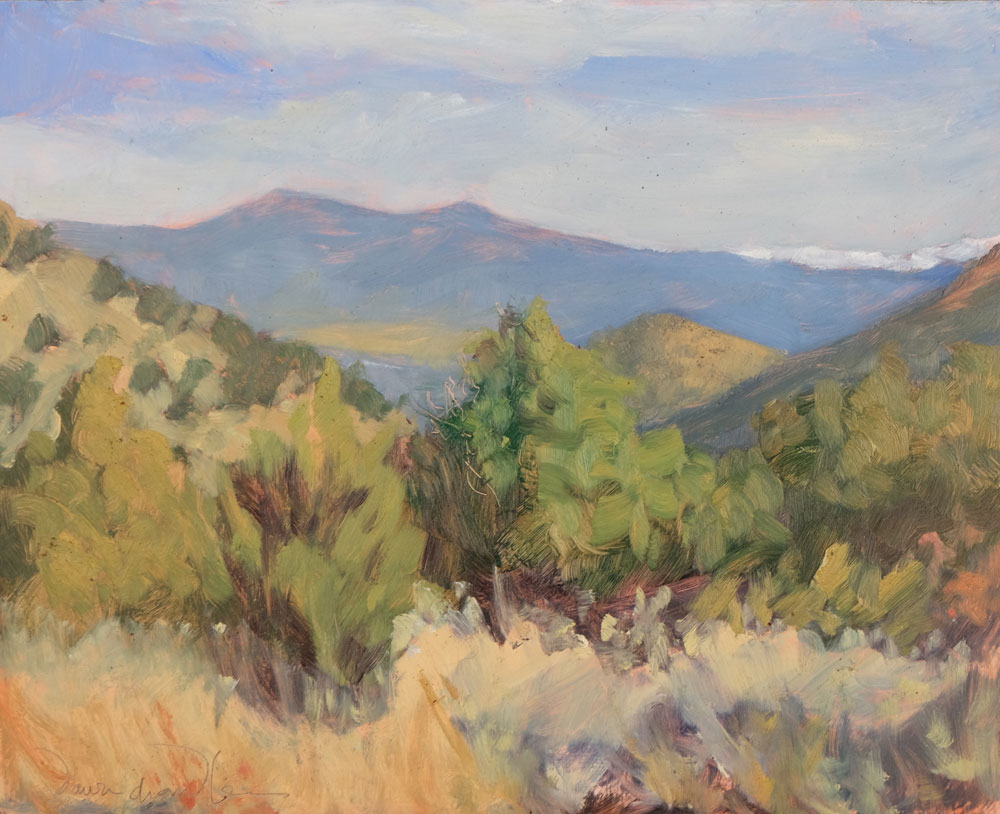
‘leap day along the turquoise trail’ ~ by dawn chandler ~ en plein air oil on panel ~ 8 x 10 inches
And that’s exactly what I decided to do two days later, on the 85th anniversary of my dear late father’s birth: To do it, to take the leap. To plan ahead, get all my gear together and get in my car and drive. And then pull over, pull out my paint box, nuzzle my pooch, take a swig of coffee and leap into painting. For what better way to honor my father, who loved art and the outdoors and who provided for me to be an artist. My Dad whose own life led directly to my charmed life—head colds and mold and car repairs and paw surgeries notwithstanding.
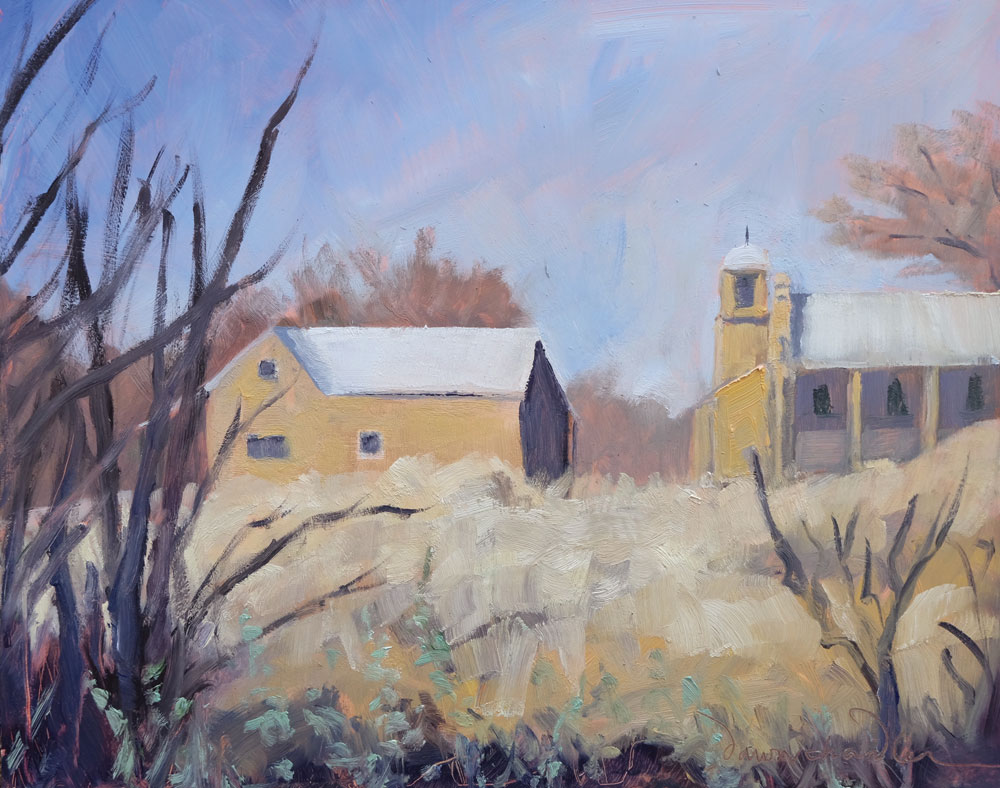
“midwinter ~ lamy, new mexico” ~ by dawn chandler ~ en plein air oil on panel ~ 8 x 10 inches